


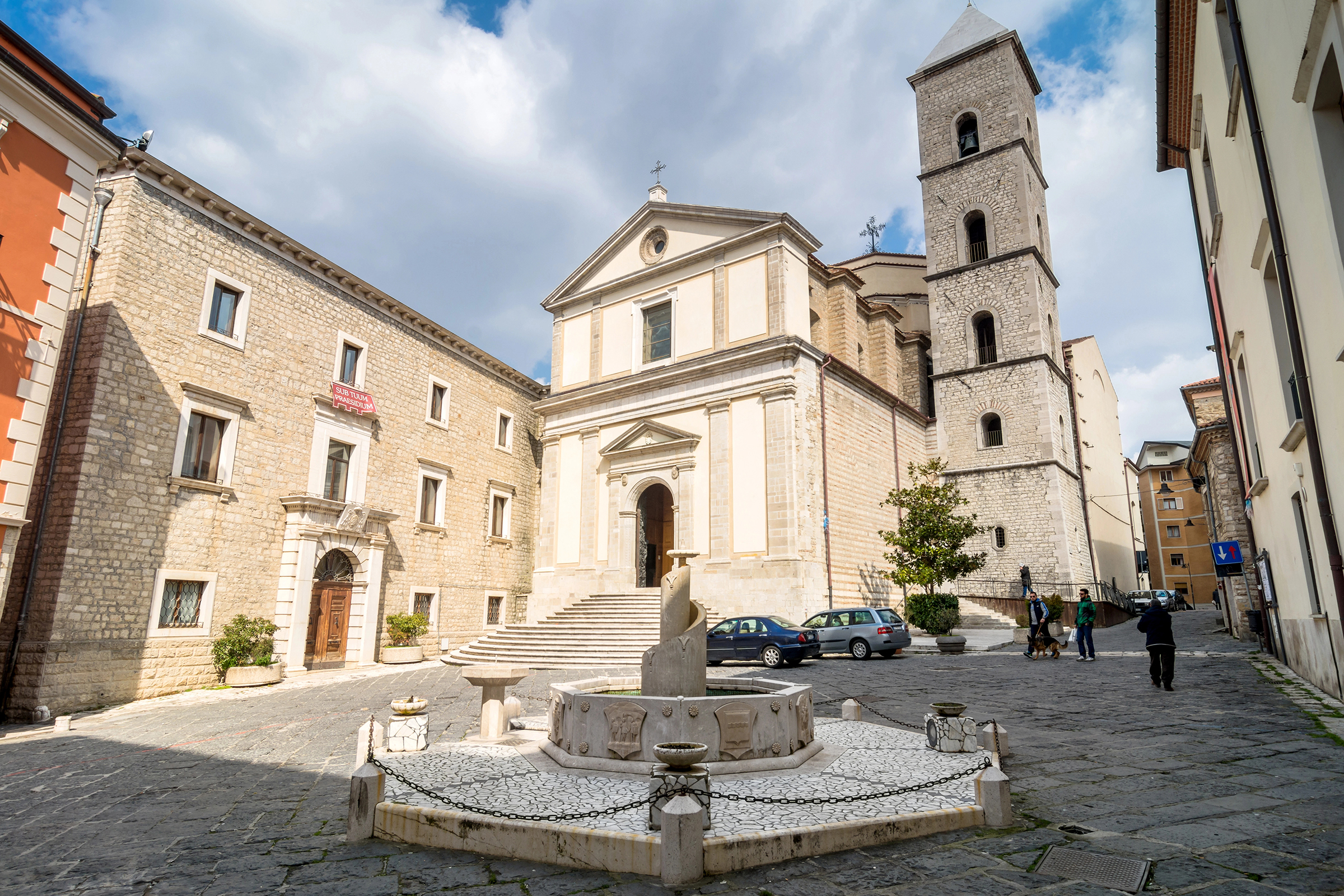
The building, erected on the ridge of the hill adjacent to the medieval public road and dedicated since time immemorial to the Blessed Virgin of the Assumption, displays eighteenth-century exterior features designed by architect Magri, a pupil of Vanvitelli, commissioned by Bishop Giovanni Andrea Serrao (1783-1799). Its ancient and venerable history, marked by earthquakes such as the one in November 1980 and persistent reconstructions, is evidenced by the discovery, during consolidation and restoration work carried out in the late 1970s, beneath the floor level in the presbytery area, of fragments of a mosaic floor and some wall structures, including one shaped like an exedra. Dating from the 5th-6th centuries, they can be traced back to the shrine of Saint Orontius, an African martyr and the city's first patron saint.
The second construction phase, connected with the change of dedication to Gerardo della Porta (1111-1119) canonized by acclamation by Pope Callixtus III, dates from between the 12th and 13th centuries and is attributed to Bishop Bartolomeo (1197-1206): from this period remains the magnificent stone bell tower, probably the work of Sàrolo di Muro Lucano. Oberto from Potenza, bishop of the city in 1250, erected a chapel to St. Gerardo, placing there a gilded wooden statue of the patron saint. From the records of the Sacred Visits of 1566 and 1571 conducted by Bishop Tiberio Carrafa, the cathedral is documented as decorated with numerous frescoes on the walls and in the chapels, and equipped with a silver arm reliquary of St. Gerardo.
The vault is currently covered with frescoes commissioned in 1933-34 by Bishop Augusto Bertazzoni from painter Mario Prayer, who also worked in the cathedral after the aerial bombardments of September 1943. Since the summer of 1968, the Potenza Cathedral has been equipped with bronze doors placed on the main facade, the work of Calabrian sculptor Giuseppe Niglia, depicting the Redeemer, the Turks, and the people of Potenza.